
AI in Insurance: How Automation Is Transforming Customer Service
Insurance has always run on information. Proposal forms, policy documents, renewals, checks and a constant flow of emails. For the customer, all of this has often meant waiting: for a quote, for a certificate, for news about a claim.
Artificial intelligence is starting to change that. Used well, AI in insurance takes the repetitive work off people’s desks and gives them back time for what actually matters, which is advising and helping customers.
In this article I want to look at what AI can realistically do for insurance customers in Cyprus, whether you are an individual, a business or one of our partners. I also want to explain why I believe the real benefits start with something much less exciting than the technology itself: automating everyday processes and checks.
Automation and AI: what is the difference?
People often use the two terms as if they meant the same thing. They don’t, and the difference matters more than it seems.
Automation follows rules that someone has defined in advance. A renewal reminder goes out 30 days before a policy expires. A policy cannot be issued while a mandatory field is still empty. It is fast, predictable and easy to check afterwards.
AI is useful where fixed rules are not enough. It can read a scanned document, understand a question written in everyday language or notice an unusual pattern hidden in thousands of records.
In practice you need both. A well-organised, automated process comes first, and AI is added on top where the information is messy and needs to be understood. If the process underneath is broken, AI will simply repeat the same mistakes, only faster.
How AI in insurance improves the customer experience
The first thing a customer notices is speed. When information is collected once and then reused, a quote for a standard product can be ready in minutes instead of days. AI can also read documents such as a vehicle registration or a previous policy schedule and pull out the details, so nobody has to type the same information twice.
Claims are where speed matters most. A claim notification can be recorded, sorted by urgency and passed to the right handler straight away. The customer then receives updates without having to call and ask where things stand.
Many questions also come up outside office hours. A digital assistant can answer the general ones, like what a cover includes or when a renewal is due, and pass anything that needs advice to a person the next morning. Automatic reminders before a renewal date, or when a document is missing, mean customers hear from us before a problem appears, not after.
None of this makes the service less personal. When routine tasks run quietly in the background, our people have more time for the conversations that really need them.
Automated checks: fewer errors, more confidence
Behind every policy there are dozens of checks that the customer never sees. Done by hand they take time, and a detail missed today can cause trouble months later. An automated check runs every time, on every record. Some typical examples:
- Making sure all the required details are there, the dates make sense and the vehicle information matches the registration.
- Customer identity, anti-money-laundering and sanctions checks running in the background.
- Flagging duplicate submissions or patterns that may point to fraud, so that someone can take a closer look.
- Matching incoming payments to the right policy, so the customer’s account is always up to date.
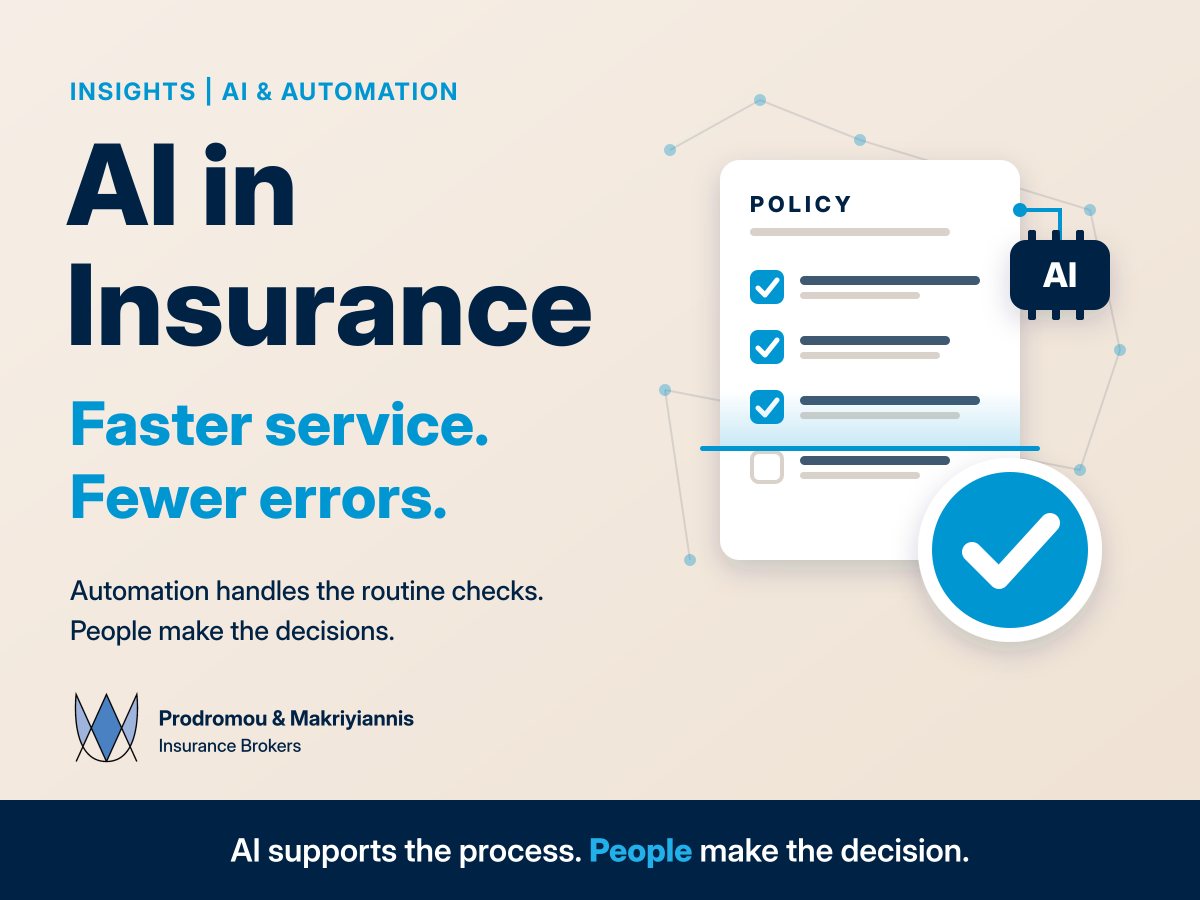
The rule here should be simple. The system flags, a person decides. Errors are caught before they reach the customer, and every exception is reviewed by someone who understands the case.
What it means for businesses and partners
Business clients often manage several policies at the same time. With automation, fleet updates, staff changes and certificate requests can be handled in bulk rather than one email at a time, and reports on premiums and claims become clearer and quicker to produce.
For our partners and associates, the biggest gain is less back-and-forth. Online quotations, real-time visibility of policy and claim status and automatic notifications replace a lot of phone calls and emails. Partners can answer their own clients faster, with information they know is current.
Responsible AI: people stay in charge
AI is a powerful tool, but in insurance it has to be used with care.
Decisions that affect a customer, such as what is covered, what it costs or whether a claim is paid, should be made or confirmed by qualified people. AI can prepare the ground and point out what needs attention. It should not have the final word.
Europe has also set clear rules. The EU AI Act classes AI used for risk assessment and pricing in life and health insurance as high-risk, and the strict requirements for these systems apply from 2 December 2027.
Customer data is protected by GDPR, and using AI responsibly means using only the data that is needed, keeping it secure and being open about how it is used. Insurance is built on trust, and any use of AI has to strengthen it.
Our approach at P&M
At Prodromou & Makriyiannis Insurance Brokers, we already use AI tools to support our internal work, such as drafting, research and analysis, under internal rules of use. Decisions about our customers are always made by people.
We are now exploring how further automation of our processes and checks can help us serve our customers and partners even better. What we want is faster answers and fewer errors for our customers, and more time for our people to give proper, personal advice.
If you would like to know more about how we work, or have a question about your cover, contact us and a member of our team will be happy to help.
Frequently asked questions
Will AI replace my insurance broker?
No. AI takes over routine tasks such as data entry, reminders and standard checks. Choosing the right cover and helping you when something goes wrong still needs experienced people.
Does AI decide my premium or my claim?
It should not decide on its own. Responsible use means AI supports the work, while qualified people make or confirm decisions that affect customers.
Is my personal data safe when AI is used?
Customer data is protected under GDPR. Responsible use of AI means using only the data that is needed, keeping it secure and being transparent about how it is used.
How does AI in insurance benefit customers in Cyprus?
The main benefits are faster quotes, less paperwork, quicker claims handling and fewer errors. Customers get answers sooner and spend less time repeating the same information.
What is the EU AI Act?
It is the European Union’s law on artificial intelligence. It sets rules according to the level of risk, with the strictest requirements for high-risk uses, such as risk assessment and pricing in life and health insurance.
About the author
Kyriakos Kontos is the IT Manager at Prodromou & Makriyiannis Insurance Brokers. He has worked with the company for around nine years on insurance systems, process automation and cybersecurity.