

Uninsured Losses and the Need For Better Understanding
When a storm floods a ground-floor shop or a wildfire reaches the edge of a village, the damage is done within hours. Paying for it can take far longer.
In Cyprus, that cost has almost always been carried without insurance.

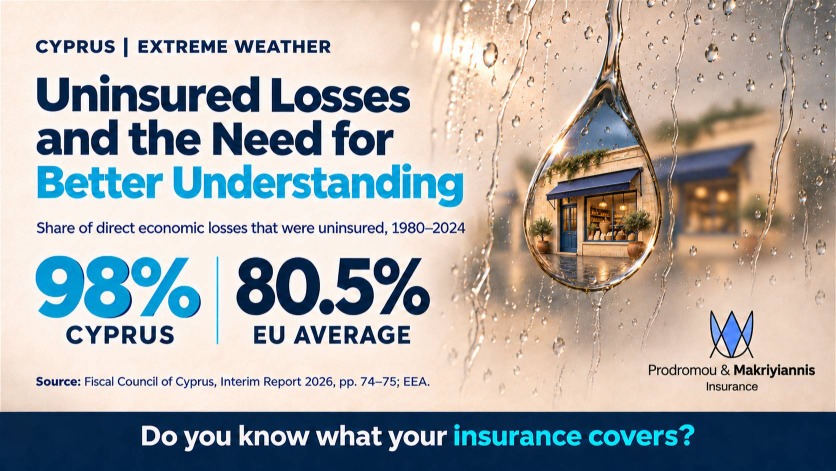
98% of the direct economic losses from extreme weather and climate events in Cyprus between 1980 and 2024 were not covered by insurance. Across the European Union, the figure was 80.5%. Fiscal Council of Cyprus, Interim Report 2026
Key points
- 98% of direct weather and climate losses in Cyprus over 1980–2024 were uninsured, against 80.5% in the EU.
- The figure refers to past losses. It does not mean that 98% of properties are uninsured today.
- Recovery usually costs more than the repair: contents, stock, temporary premises and time out of operation.
- Five areas are worth reviewing, set out below.
What the numbers tell us
The estimate comes from the Fiscal Council’s 2026 Interim Report, published in September 2026 as part of its assessment of climate-related risks to the public finances.¹ It is consistent with data from the European Environment Agency, which places Cyprus among the countries where less than 3% of these losses were privately insured over the same period.²

Chart: Share of direct weather and climate losses that were uninsured, 1980–2024 — Cyprus 98%, European Union 80.5%
It is worth being precise about what the figure means. It describes losses that have already happened, not the share of properties that are insured today. It says nothing about any individual policy, and it is not a forecast. It also covers direct damage from weather and climate events only, so earthquakes and wider economic effects are not included.
What it does show is who has carried the cost. When a loss is not insured, recovery is paid for by the owner or the business itself, through savings, borrowing or whatever support happens to be available.
The damage is rarely the whole cost
Repairing the building is often only the first part of the bill. Contents, equipment and stock may need replacing. A business may need temporary premises while work is carried out, and loan repayments, salaries and rent continue in the meantime.
For businesses in particular, the disruption can last well beyond the event. Replacement equipment can take weeks to arrive, and access to premises may be restricted for some time. None of this is captured in the direct-loss figures above, which is one more reason to look at cover as a whole.
Five areas worth reviewing
01 — What the policy actually covers Storm, flood and wildfire are not treated in the same way by every policy. The definitions, conditions and exclusions determine what is covered, so they deserve a careful read rather than an assumption.
02 — Whether the insured values are still right Buildings, contents, equipment and stock each need an appropriate sum insured. For buildings, the relevant figure is the cost of rebuilding, which can be quite different from what the property would sell for. Renovations, new equipment or higher stock levels are all good reasons to revisit these amounts.
03 — The share of a loss you would carry The excess is the part of a covered claim paid by the policyholder. Limits and sublimits can also affect what is payable. Knowing these figures before a claim makes it much easier to plan for the portion of a loss that would fall on you.
04 — How the business would cope with an interruption Where business interruption cover is in place, it is worth checking what triggers it, which losses it can include and how long it can respond. The indemnity period should reflect how long recovery would realistically take. This cover is subject to policy terms and may depend on insured physical damage having occurred first.
05 — What has changed since the policy was arranged A policy set up a few years ago may no longer reflect how a property is used, what a business does or what it owns. Any material change is worth discussing with your insurance adviser.
Preparation matters as much as cover
Insurance works best alongside practical steps that reduce damage in the first place. Depending on the property, that can mean keeping roofs and drainage in good condition, protecting equipment that is vulnerable to water or heat, maintaining an up-to-date inventory of assets and storing important records securely.
For businesses, it also means having a plan: how staff, customers and suppliers would be contacted, how essential information would be accessed, and how the most important work would carry on.
“The 98% figure describes Cyprus as a whole. For any one owner or business, the questions are narrower: what the policy includes, where its limits lie, and whether it still fits.”
At Prodromou & Makriyiannis Insurance, we believe that the better our clients understand their cover, the better placed they are to make sound decisions about the risks they face.
Sources
- Fiscal Council of Cyprus, Interim Report 2026 (Ενδιάμεση Έκθεση 2026), Section 6.5 and Chart 53: https://www.fiscalcouncil.gov.cy/assets/modules/wnp/articles/202609/101/docs/fccinterimreport2026full.pdf
- European Environment Agency, Economic losses from weather- and climate-related extremes in Europe (October 2025): https://www.eea.europa.eu/en/analysis/indicators/economic-losses-from-climate-related
Figures verified on 10 November 2026. The latest comparable data for Cyprus cover 1980–2024. This article is for general information only. Cover and claims are subject to the terms, conditions, limits and exclusions of the individual policy.