

Insurance Is Not a Painkiller
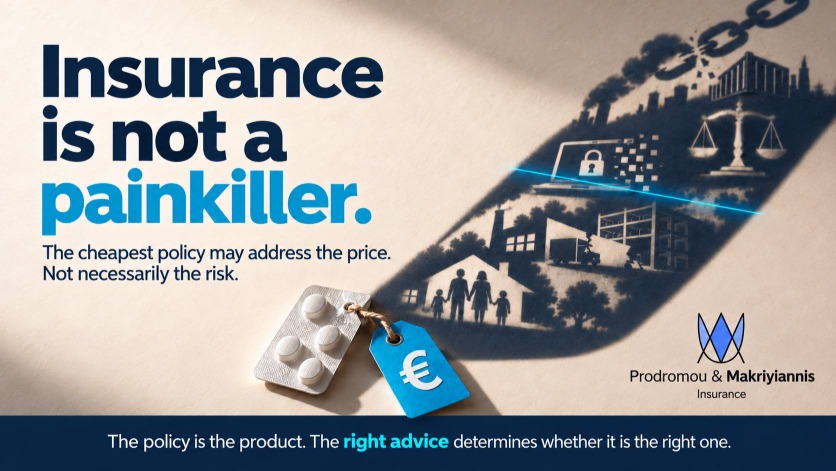
The value of the right advice before choosing an insurance solution
By Kyriacos Andreou, Deputy General Manager, Prodromou & Makriyiannis
A painkiller can stop the pain. It cannot make the diagnosis.
Imagine someone who has been experiencing persistent pain for several days. Instead of consulting a doctor, explaining the symptoms and undergoing the appropriate examinations, the person chooses the easiest option: a painkiller.
The pain subsides. Temporarily.
The painkiller was inexpensive, readily available and provided immediate relief from the symptom. But it did not answer the most important question: What is causing the pain?
If the cause is minor, the choice may have no serious consequences. But if the pain is a symptom of a more significant condition, temporary relief can create a dangerous sense of reassurance.
Something similar can happen with insurance.
The cheapest policy may address the price but not necessarily the risk.
Access to insurance is easier than ever. Consumers and businesses can search for cover online, compare prices and, in many cases, complete a purchase without a substantive discussion with a professional adviser.
That is not inherently a bad thing. Technology, simpler processes and competition have delivered important benefits to customers.
The problem begins when ease of purchase is confused with quality of decision-making.
Just as a painkiller can suppress pain without diagnosing its cause, an insurance policy chosen mainly because it is easy or inexpensive can create the feeling that “I am insured” without first answering the more important question: “Am I properly insured for the risks I actually face?”
Diagnosis first. Treatment second.
A good doctor does not begin with the medicine. The doctor begins with the patient.
The symptoms are considered. Medical history is reviewed. Risk factors are assessed. Tests may be requested. Alternative diagnoses are considered. Only then is the appropriate treatment recommended.
Professional insurance advice should follow a comparable logic.
Before choosing an insurer, policy or premium, the risk itself must be understood. What exactly are we trying to protect? Which events could cause the greatest financial damage? What sums insured and liability limits are appropriate? Are there material exclusions or restrictions? Which risks can the insured reasonably retain, and which should be transferred to the insurance market?
This is the “diagnosis” that should come before the policy.
Advice matters because an insurance policy is not as simple as it may appear
In insurance, the customer pays today for a promise whose quality may only be tested years later. In many cases, the true quality of what was purchased becomes clear only when a claim occurs.
Until then, two policies can look almost identical: the same sum insured, similar headline covers, one costing €900 and the other €1,200. The comparison appears straightforward. It is not.
Behind the difference may be different definitions, exclusions, warranties, deductibles, sub-limits, conditions, extensions or bases of settlement.
The real comparison is therefore not simply “€900 versus €1,200”. It is: “What am I buying for €900 and what am I buying for €1,200?” More importantly: “Which solution actually responds to my risk?”
A professional insurance intermediary should not “prescribe” before understanding the problem
This is where the real value of professional insurance intermediation lies. Not simply in finding a policy, and not in justifying a higher premium, but in asking the right questions before recommending a solution.
A professional insurance intermediary should understand the client’s needs and circumstances, identify material risk exposures, explain the available options and their limitations, and help the client make an informed decision.
Sometimes the right advice may even be that the client does not need more insurance. The client may need better cover, different limits, risk improvement measures, or a higher excess so that the available budget can be directed towards a risk capable of causing genuinely serious financial loss.
That is advice. And it is very different from selling.
Cheap is not wrong. Inappropriate is.
A cheaper policy is not necessarily an inferior policy. Nor is buying insurance directly or digitally inherently wrong. For simple, standardised risks, it can be an entirely efficient solution.
Just as a painkiller may be exactly what is needed for a simple headache.
The critical issue is knowing when the case is genuinely simple.
As risk becomes more complex, the value of specialist advice increases. A family with significant financial obligations, a professional exposed to Professional Liability or Cyber risks, or a business with substantial assets, employees, contractual liabilities, Business Interruption exposure, critical suppliers or Key Persons is not simply buying another product. It is trying to protect something that may have taken decades to build.
The moment of truth
In medicine, a wrong diagnosis may become apparent when the treatment fails. In insurance, a wrong decision often becomes apparent when a claim occurs.
By then, it is too late to change the wording. Too late to increase the sum insured. Too late to remove an exclusion. Too late to add a cover that was never purchased.
This is why much of the value of good insurance advice is created before the loss: in the analysis, the questions, the identification of exposures, the selection of the appropriate solution and the explanation not only of what is covered, but also of what is not.
Insurance is the tool. It is not the diagnosis.
Perhaps this is the most important distinction between simply buying insurance and receiving professional insurance advice.
The first may begin with the question: “How much does it cost?” The second should begin with: “What risk are we actually trying to address?”
Just as we would not want a serious health problem to be treated only with a painkiller because it was the easiest and cheapest option, we should not assume that simply purchasing an insurance policy means that we are properly protected.
The policy is the product. The right advice determines whether it is the right product for the particular risk.
When the objective is to protect what we have built, the quality of advice may ultimately prove far more important than the price of insurance.